The Ultimate Minority

Whenever you find that you are on the side of the majority, it is time to reform – Mark Twain


In the world of publicly traded corporations, if one company finds itself failing to appeal to investors by creating natural growth – by adding value in the marketplace and continuously reducing its cost of operations, there is a short-term fix: Mergers and acquisition.

Wall Street loves merger and acquisition activity. There is speculative buzz over “synergies” and “diversification.” Stock prices jump, and shareholders reap short term rewards.

Further, when a company in a sector of industry finds its competitors on an M&A spree, there is often pressure to join in, lest they be left behind. The competition is growing faster, their presence on the stage has been enhanced; they are attracting investment.

But if the company was failing to increase their value naturally in the marketplace prior to engaging in M&A activity, the underlying systemic weaknesses will not been fixed by merger and acquisition.

In fact, these structural weaknesses are compounded as the company attempts to integrate the disparate business systems, practices, and cultures of the organizations. Through forced growth, the acquiring company has further taxed its already troubled core operation system. Administrative costs begin to outpace growth in sales. The system begins to collapse upon itself. As the company struggles and its stock price once again declines, the quick fix solution is found in selling, or spinning off, companies that were previously acquired.

It is often revealed, then, that M&A activity is a shell game designed to prop up an underperforming company’s image in the market, hiding their ineffectiveness while encouraging investment in their operations.

The international currency markets are a speculative in their nature. What makes one fiat currency more valuable than another? Economic strength, military strength, and national credibility on the world stage are some the drivers of strength in currency.

The United States and its Federal Reserve System have benefited for decades as issuer of the worlds reserve fiat money. A once great productive economy, coupled with our status as the worlds largest market, US military superpower status, and even our image as a champion of freedom on the world stage has propped up the dollar and the US government.

Inevitably, this power to print fiat money, accepted around the world, would lead to accelerating destructive inflationary policy. And the Federal Reserve has not disappointed. What are the results?

Like Aesop’s Goose, the vast natural resources and creative force of US industry produced golden eggs in the form of productivity and an ever expanding economy. And the Federal Reserve, not unlike the farmer, has slaughtered the goose to get the rewards, wiping out productivity with inflation. Consumption based on debt has diminished our status as the world’s largest market. Our military might, imposed on the rest of the world through imperialism and interventionism, is increasingly viewed with scorn. Our image as a champion of freedom, while installing and supporting dictatorships that are puppets to the Empire; while our government destroys liberty at home at an unprecedented rate, is revealed as hypocrisy.

Enter the European Union, a merger on a grand scale. Suddenly, a competing fiat currency has gained esteem by increasing its base of operations: The productivity that it relies on, the expanded base of taxation that it acquired. The Euro has stolen the thunder from the US dollar, and has gained strength on world currency markets.

And now, the dollar is slipping. Oil producing nations seek to disassociate their product from the dollar. A mercantilist US government responds in desperation by placing military and political pressure on their regimes, and worse yet, by printing more of the declining currency and sending it to them to buy their support.

The US government and its central bank are desperate to prop up the value of their fiat currency. Without the dollar’s perceived value, the world will not accept it and finance the government’s debt. They have destroyed the very foundation of its prestige.

The pressure is on, others are propping up the value of their currency through mergers. Isn’t it the US Governments turn to get in on the action?

The Federal Reserve System is the master of all shell games, ever generating new schemes to inflate the currency and expand government. Is it foolish or conspiratorial to think the merger tool is not in their bag of tricks?

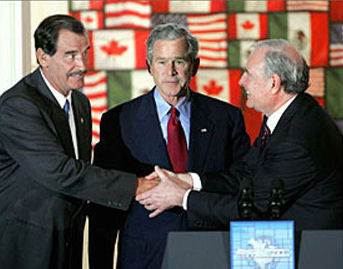
The natural course of action would be to expand its base of operations through merger and acquisition. A North American Union would add people and industry (read: A much larger tax base from which to sop up productivity) and a larger regional influence to the fiat money. Speculators would see the larger asset base as representing value. The counterfeiters would buy more time for their useless paper.

Viewed from this perspective, one can see where a North American Union, and an “Amero” replacing the dollar would not only be beneficial to the central bank, but may be their only conceivable course of action to save themselves. Consider this when you read mainstream media reports that this is all a conspiracy.

If the American people ever allow private banks to control the issue of their currency, first by inflation then by deflation, the banks and the corporations will grow up around them, will deprive the people of all property until their children wake up homeless on the continent their fathers conquered. The issuing power should be taken from the banks and restored to the people, to whom it properly belongs. – Thomas Jefferson

Previous entries:
Part 1
Part 2

It’s a situation I think that the American people will understand if it’s ever brought to them, except there’s just no politician out there who’s going to do it, as far as I can tell.Michael Scheuer, October 22, 2005.

Have you ever read about the reasons they attacked us? They attack us because we’ve been over there, we’ve been bombing Iraq for ten years. – Ron Paul, May 15, 2007

I just had to post that Scheuer statement and the subsequent Ron Paul statement because when I heard the Dr. Scheuer interview just a few months ago, it was funny to note that history had proven him wrong – Ron Paul stepped up to the plate and delivered the information to the people.

So let’s address Dr. Paul’s key question. Could it really be that simple?

Going back to my statement that for any set of circumstances, there are many answers provided for the problem – many conflicting answers – but there is always one key question: From the perspective of root cause analysis, the key question is the one that leads to and addresses the root cause. All of the proposed “solutions” are varied and conflicting because they address symptoms, which are the many outcomes of the root cause. They are not causes in and of themselves, but are the systemic effects of the root cause. Working on the symptoms does not fix the problem, in fact, it often makes it worse. Statistically speaking, this is known as tampering with the system. It confuses and distracts us from the root cause with a tangled web of cause and effect created by the tampering. I’ll work on root cause analysis and tampering further in another post, but for now, suffice it to say that discovering and working on the root cause is the key to solving a problem, while working on the symptoms does not improve the system, and usually only makes it worse.

Ron Paul’s question cuts to the heart of the problem:

The problem is a foreign policy of interventionism.

What motivates someone to give their own life in a suicide attack? Do they hate us because we’re rich and free, because our women wear skirts, because of our movies? And if they did, would that be sufficient to motivate them to carry out a suicide attack? A partial answer can be found in the observation that the Ayatollah Khomeini tried for two decades to motivate people to hate Americans for these reasons. It didn’t work.

A more concise answer is provided by Dr. Robert Pape, who is considered the world’s foremost authority on suicide terrorism. Dr. Pape has cataloged all of the suicide attacks in the world, going back to 1980. He researches the motives behind each of them, as stated by the groups sponsoring the attack. His data is conclusive: The motivation for 95% of all suicide attacks has been military occupation – especially when it is an occupation by a people of a different religion. Al Qaeda recruits suicide attackers from volunteers, not its long-time members. These are people who feel their backs have been pushed against the wall. Perhaps they’ve lost a family member to war or occupation, or perhaps they are Islamic fundamentalists with a belief that the US has launched a war against their religion. Either way, they are willing to give their lives to stop it.

Michael Scheuer, the former 14-year head of the CIAs Bin Laden unit, explains that Al Qaeda lured the US government into war in the Middle East with the attacks of 9/11 because of its interventionist foreign policy; citing US support for Israel, occupation of the Arabian peninsula, occupation of Muslim countries, mercantilist oil policy, alliances with governments that oppress Muslims, and support for Arab tyrannies and police states.

With a clear understanding of the problem, we see that the solution is simple: An immediate and full scale withdrawal from Iraq. An example of working on the symptoms is the escalation (aka “the surge.”) It is an attempt to gain control by pushing harder, with the belief that the problem is internal violence, and the solution is more control. Internal violence is a symptom, a result of a foreign policy of intervention and its concomitant manipulation, war, and military occupation. Escalation, then, does not solve the problem, it makes it worse. Withdrawal addresses the root cause and solves the problem.

What is the best way to protect American citizens? To put a halt to the activities of the US government that generate hatred and violence toward us. This means minding our own business, ending the policy of foreign intervention. The people of other countries that are having problems with their own governments will focus there efforts where they belong: Fighting their own government’s oppression. The US, minding its own business and promoting liberty at home, can serve as the example; the shining beacon of freedom to which others aspire. This is a policy of non-interventionism, and it is distinctly different from isolationism. Isolationists want to cut ties with the rest of the world, withdraw, and raise the barriers. Non-interventionists encourage trade and practice diplomacy, but do not engage in entangling alliances.

Intervention doesn’t only mean war and occupation. It also encompasses manipulation of foreign governments, taking sides in conflicts, and subsidizing or sanctioning other nations. Notwithstanding the unconstitutionality of using American taxpayer’s hard earned money to send to foreign governments, the money finances violence against the peoples of other nations. The money always goes to the dictators and tyrants, fueling anger toward the US by the oppressed. Economic sanctions don’t hurt governments; in fact, they assist them by redirecting anger from local government to the oppressive empire. The world of Islam is quite divided in terms of sectarianism, different theological interpretations of Islam, ethnically and linguistically – but mutual hatred for US foreign policy helps them paper over their differences and unite against a common enemy.

Let us return to Randolph Bourne’s statement: War is the Health of the State. What is government’s interest in war?

Thomas Jefferson noted that it is the natural course of things for governments to grow in power and for the people to yield liberty. This process is accelerated in times of war. The people, desperate for safety, willingly cede their liberties to the government for more protection. The opportunistic government, always seeking to expand its power and control over the people, generates a constant stream of bogeymen to keep the people in fear. There’s always another Hitler. The so-called “war on terrorism” is perfect for government because the enemy can never be defined or eliminated. It is a perpetual war.

War rallies the people around their government. With the puppet media as its propaganda horn, jingoism and belligerent nationalism are the order of the day. Flags fly and “support the troops” magnets adorn vehicles. French Fries become “Freedom Fries.” George W. Bush’s approval rating dropped as low as 51% before 9/11. Immediately after 9/11, it skyrocketed to 90%, the highest approval rating ever seen in a Gallup poll. The worst despots in history have always been able gain the support of the people when they’re at war.

The Military Industrial Complex benefits from interventionism. War, of course, is profitable for the MIC. When the US government is at war, or when it is subsidizing foreign militaries; guns, bombs, and war machines are in demand. Times of peace are times of doom and gloom in the MIC. Destruction of infrastructure generates rebuilding contracts for favored contractors. The MIC looms large over Washington with powerful lobbying interests, constantly pushing for more intervention. When the MIC benefits, elected and unelected officials benefit. Big money awaits those moving through the revolving door of politics, executive positions in the MIC, and lobbying firms representing their interests.

And so there you have a vicious cycle: Government intervention begets violence against US citizens, the government responds with war, the people rally around the government, give up liberty for safety and lose both, government grows in size and power and steps up its intervention. War is indeed the Health of the State.

I might add “until the state has destroyed the wealth that created it and implodes.” History has shown time and time again that this does not end well.

Epilogue

I am not a pacifist. I believe in self defense, I will fight when threatened, and I believe that there are some people who could use a good killin’. My views expressed here represent a personal awakening – to understanding that the US government is not protecting us, and that in fact, it is our biggest threat. Once again, we have seen the enemy and it is us.

Looking back, it would be easy to feel guilty about being a war supporter and a fool for government propaganda, but my view is that free people don’t want to be involved in government and world affairs. They are busy providing for their families, worrying about their day-to-day business, seeking their own goals. Most people simply want government to do its job; give them what they expect from government when they want it, and leave them alone the rest of the time. But as the vicious cycle repeats itself, the situation for the people worsens. There comes a time when enough is enough, each of us has our own limits. I only hope the American people wake up before it goes too much further; this loss of freedom and the rise of tyranny. I’m encouraged by the words of Samuel Adams, who said that it does not require a majority to prevail, but rather an irate, tireless minority keen to set brush fires in people’s minds. That is my purpose in these posts.

If there is to be a Second American Revolution, let it happen in my lifetime. I would rather be part of the fight than to be responsible for passing the burden to future generations.

Men, it has been well said, think in herds; it will be seen that they go mad in herds, while they only recover their senses slowly, and one by one.
-Charles Mackay

I wish to extend a debt of gratitude to Ron Paul, the late Murray Rothbard, and Lew Rockwell and the Mises Institute for helping me recover my senses.
I have the login / commenting issues worked out (at least, to the best I could tell through my testing.) Sorry about the frustration some of you have experienced. I’m just getting used to this software.

I hope it’s not like my old 1970 Ski-Doo Olympique 300 – I spent more time working on that sucker than riding it…

This will be a good piece to listen to before (or after) I write part 3 of War is the Health of the State.

Dr. Michael Scheuer was the head of the CIA’s Bin Laden unit for 14 years. He has authored several books on US foreign policy, imperialism, and terrorism. While I disagree with Scheuer on his solutions, and even find some of his CIA-brand commentary shocking (yet interesting,) his analysis of the problem is spot-on.

This is also a great introduction to the Scott Horton interviews. His irreverent style, great quips and a tendency to go on rants are well represented in this bit. I don’t miss a single one: Scott Horton interviews Michael Scheuer – May 19, 2007

As a follow-up to Part 2 of “War is the Health of the State – A Personal Evolution”, I present the May 15, 2007 Republican debate, where the heroic Ron Paul asks the key question and Rudy 9ui11iani responds with his museum-quality brand of jingoism.


Previous entry: Part 1

Somewhere between the first gulf war and until the past few years, I became withdrawn from news and world events. Much of it was due to my contempt for television news and mass media (the last straw for me was when television crews were on the scene to show us Tonya Harding running down the street crying after her car had been towed, shortly after the whole Nancy Kerrigan affair.) I had also entered into a new phase of reading and learning, and chose the study of ideas and theory over the discussion of – and reaction to – events.

9/11 shook me out of my theory tree house for a while, and brought me back to watching television news and discussing current events. Like everyone I knew, I struggled with the questions: Why do they hate us? What motivates these people to hijack planes and fly them into buildings? I was angry and did not know how to react to what appeared to be a new paradigm of threat to our safety. I remember posting on a web forum some inane, propagandistic comment that I had probably picked up from some talking head in the news: This is a new kind of war, our enemies could be living among us. We must be diligent, they are attacking our way of life.

Soon, the President was on our television screen proclaiming that we would scour the ends of the earth, find those responsible, and bring them to justice. I’ll always remember where I was – at a pub in Memphis. The music was playing, we were all enjoying our beer and conversation. Suddenly, the music stopped and the TV was patched in to the audio system. The crowd watched and listened as George W. Bush made his announcement. As he concluded, the crowd cheered. We were going to war against terrorism. We would get our revenge.

I paid attention to the news as we quickly routed Afghanistan, listening and waiting for the news of Osama Bin Laden’s capture. In the ensuing year or so, my interest waned as the conflict went on. Then the drums of war started beating to invade Iraq. I started watching again, listening to the claims of Sadaam’s involvement in 9/11, his support for Al Qaeda, and his weapons of mass destruction. By this time, I was beginning to ask more questions and not feeling so comfortable with government claims, as I read conflicting opinions on the threat posed by Iraq. When the invasion of Iraq commenced, I tuned in and watched, but I remember feeling much different than I did in the first Gulf War. As the Iraqi invasion and occupation wore on, I once again withdrew from participation in the debate.

Looking back, I realize that the with all the complexity of the events, the claims and counter-claims, all of it was just too much to digest. I listened to the talking heads and how they would criticize the American people for their lack of understanding of geography and world events, how we are all ignorant about the cultures and histories of other countries until we’re at war with them. I watched as the talking heads themselves scrambled to pose as experts on the Iraqi culture and politics – the Shiites, the Sunnis, the Kurds, the Ba’athists…At some point, I think the average Joe simply goes along, willing to leave the complexity to the experts. My own reaction was to feel that something was going wrong, but I didn’t feel I had any control. Once again, I withdrew interest. My personal life was filled with complexity, buying a business and building it. I had plenty to keep me busy.

My aforementioned phase of deep study in theory led to one of my guiding principles in life: That for any set of circumstances, there is no shortage of answers. Everyone has a solution, they are many and conflicting. But there is usually only one key question.

Sometime in June, 2007, I decided to look up the 2004 Libertarian Party presidential candidate, Michael Badnarik. I had voted for him in 2004, election politics (from which I had traditionally distanced myself) was stirring again, and I wondered if Badnarik was going to run in 2008. I found his website, where I read that he was putting all of his efforts into seeing that Ron Paul was elected President. My first question was “who is Ron Paul?” I searched the web, and was led to a YouTube video of the May 15th Republican debate.

Ron Paul addressed the one key question: Why do they hate us? This began a whole new phase in my understanding of government and war.

Next entry: Part 3

Management by Objective, as practiced, loves goal setting and measurables. The old mantra “if you can’t measure it, you can’t manage it” is uttered every 1.2 seconds in some office, somewhere in America.

It works like this: Measure a result over some period of time, decide on a goal for better numbers, communicate that goal to subordinates, and hold them accountable for attaining the goal. On-time shipments averaged 80% over the last year? Set the goal at 90%. Average GPA for a student body is 2.0? Mandate a requirement that the school reach an average of 2.5 within three years. This is also the favored method of the bureaucrat and the central planner.

When Dr. Deming spotted such practice, he would always ask: “By what method?” How would you attain such a goal? And if you could get better results simply by decree, what prevented you from doing it the year before?

“Must have been goofing off”, Deming chided.

Brian Joiner expanded on Dr. Deming’s work by teaching that there are three ways you can get better numbers out of a system:

1) Improve the system.

2) Distort the system.

3) Distort the numbers.

That’s it. Three choices. The subjects, given a new goal to reach, will follow one of the three methods. Let’s look at methods #2 and #3 first, since lacking any tools and methods for real systemic improvement, people usually resort to one or the other. Method #2, distort the system, may take the form of “show me what you’ll measure, and I’ll show you how I behave.” It means that people will shift their priorities from one task to another if they know it is being scrutinized closely. Less time and effort will be spent on Task A because management has stressed that Task B must improve. Of course, Task A was the big push last month, but management can only keep up with so many priorities. As a result, we get local improvement in one area, but no real systemic improvement because some other area suffers a lack of effort or attention. This leads to management playing the old whack-a-mole game, like the one at the arcade. Holding a padded mallet, moles pop up out of holes and the player beats them down, only to have another mole pop up from a different hole, and on and on… The management version of whack-a-mole involves keeping up with all of the goals and priorities while employees shift their efforts around to meet the big push of the moment. Method #2 may also involve changing the system to its detriment to make better results, as measured, more easily attainable. In the case of student GPAs, we may simply make tests easier, inflating grades but with no net benefit to the learners.

Method #3, distort the numbers, is much simpler. We simply fudge the figures. An inspector, charged with reporting the number of defects per worker, may fail to report defects to save a co-worker from discipline or firing. The defects are hidden, the numbers get better, but quality did not improve.

There are countless ways methods #2 and #3 can be carried out, limited only by the creativity of the workers. McDonald’s installed an electronic eye below the drive-up window of their restaurants to count the cars as they pulled up. The vehicles-per-hour figures were sent up to corporate, and goals were established. A consultant schooled in the Deming management methods knew the right question to ask: “What do you do when your numbers are running low?” A grinning employee showed her – they would dangle a bag out the window, back and forth across the electronic eye to run up the counter.

Bank tellers seldom have a perfectly balanced till at the end of their work day. Overages and shortages occur. A new branch manager, intent on eliminating the problems, simply mandated that they will not be tolerated. Anyone turning in a till with anything other than a balance would face discipline, a few occurrences would result in their dismissal. Within a short time, he got his results. All of the tills were balanced, day in and day out. Corporate management was impressed and the manager was rewarded for the exemplary performance of his branch. How was it accomplished? Within the ranks of the tellers, a sophisticated banking and lending operation had developed; anyone with an overage would keep it outside the system, and would turn in a balanced till. Anyone with a shortage would borrow from the overages bank, and would turn in a balanced till.

The numbers improved, but the system did not. In fact, the effort expended in running the subsystem of banking and lending diverted time and effort from customer service and real system improvement.

If we want better results, we have to improve the system that delivers the results. Real improvement comes from the introduction of better methods, an understanding of the System of Profound Knowledge, and the methodology of the Plan-Do-Study-Act cycle.

Corporatism

1 comment

As a business owner and a true advocate of free markets, I have, in the past, had a difficult time defending free market principles when people point out the problems in areas such as health care, big pharma, and Enron-type scandals.

I found the answer in my studies on corporatism.

Corporatism is the dirty relationship between government and corporations. It is also a key component of socialism – Mussolini was a champion of corporatism. You can identify it by several characteristics, but one of the simplest and most concise measures is this: Profits are privatized, while losses are socialized.

The Military Industrial Complex is a blatant example of corporatism. When you get into the who’s who of the MIC, you find the same names popping up time and time again. These people move from government positions, both elected and appointed, to top executive positions in the companies of the MIC, and into large, influential lobbying organizations on the behalf of the MIC. It’s a giant revolving door. They are powerful, highly politically connected individuals working to benefit the corporations at the expense of the American people.

When the US government sends helicopters to South American governments to fight the “war on drugs” who do you think lobbied for this decision? Agencies representing the interests of the helicopter maker.

In the 1990s, the Mexican government went on a spree of massive inflation, ravaging their financial system. The US government and its Federal Reserve bailed out the Mexican government on the backs of the American taxpayer. Congress was against it, but the Fed got it done. It turns out that large US investment banks were holding $21 billion in bad debt to Mexican public and private institutions. A key player in the bailout was Treasury Secretary Robert Rubin, the former head of Goldman Sachs. Goldman Sachs held a large share of the Mexican debt, and shortly after the bailout reported record profits. Profits were privatized, losses were socialized. You pay the bill.

The Federal Reserve system is an 800 lb gorilla of corporatism. It is not a government agency, it is owned by the member banks. The Fed has the government protected monopoly on the printing of money. It protects its member banks from failure with the promise of simply printing more money when they make bad investments. The US government borrows money from the Fed, the Fed creates the money out of thin air, and the taxpayers pay interest to the Fed for its role in printing and supplying money to the government.

Then there’s the holy grail of the corporatist: Government contracts. You get to charge $4000 for an ashtray! It’d be pretty hard to not make a buck with that deal. When your budget estimates break down and your project is going to take twice as much time and cost twice as much money, the treasury ponies up.

Look at the whole Blackwater affair. A highly politically connected corporatist builds a security company, and contracts its services to the US government. They call it “privatizing” functions that are normally the province of government. Blackwater gets vast amounts of taxpayer money, then carries out the wishes of the government in doing its dirty work. When the actions of Blackwater are exposed, the corporatist willingly fills his role as the scapegoat.

Hearings are held and well publicized in the mainstream media. Politicians scramble for airtime in the show trial – you can actually see them chomping at the bit – grandstanding in demonstration to the masses that they are fighting in their interest, blaming privatization, challenging these greedy “capitalists” and promising more regulation and accountability. If there’s one thing a politician loves, it’s having someone to blame.

All the while, official government bureaucratic blunders, scandals, and abuses are swept under the rug as quickly as possible. The message gets out to the people: Evil private corporations are being reined in by your representatives. They can’t be trusted. Give the government more control, the market doesn’t work. It’s a win-win proposition for both parties. Government officials get to decry privatization and the market, and the corporatist gets his guaranteed profits.

The examples are many, but let’s get back to the theory and practice of corporatism. It is not the free market at work! It is a violation of free market principles.

Murray Rothbard explained that monopolies and cartels cannot exist in a free market. Let’s say the three biggest steel producers in early industrial America, together holding 90% of the market share, want to assure their profitability despite declining productivity. They band together and agree to set pricing for their products. Here’s a few of the things that will happen:

1) As prices go up, the industry will begin to seek alternative materials. Brass, aluminum, and plastics, for example. This lowers demand for the steel industry, further pressuring their efficiency and profitability.

2) High prices of steel catch the attention of entrepreneurs, who see large profits to be made in the industry. It attracts investment in smaller, leaner, more efficient operations to compete with the big three, seeking to take advantage of the handsome profit margins.

3) The big three start to undercut one another, making side-deals with their best customers…”I’m supposed to charge you x, but you’re one of our best customers. I’ll give you a 15% discount, just don’t let anyone know you’re getting this deal…”

All of these factors continue to the detriment of the cartel. Markets are swift and judicious, if you’re not providing value in the market place, alternatives will emerge.

How does the monopoly or cartel survive? By seeking protection from the government. They will agree to heavy regulation to create a barrier to entry for smaller competitors. They will seek protection from imports in the form of tariffs.

Look into any example of government antitrust legislation, and you will find that it is always to the benefit of some politically favored corporatist entity. It is always done in the name of “protecting the consumer,” yet it always benefits the few at the expense of many.

There is a symbiotic relationship between government and large corporations. Both are immensely bureaucratic, so they work on the same level. Government benefits by imposing unending regulation on the corporations in the name of protecting workers, viewed by the people as their government protecting them from greedy capitalists. The corporations benefit because the regulation burdens smaller competitors, and they get protectionist trade-offs.

New regulation that favors corporatism is sometimes hailed, sometimes opposed by the corporatist. In either case, it is a ploy to gain public support for the measure. The bankers feigned outcry over the formation of the Federal Reserve system. Government sold it to the people as a means of protecting their money from greedy bankers, and when the people saw that Rockefeller was against it, it justified their support because the baron was being reigned in by their protectors. Rockefeller, of course, was one of the architects of the Federal Reserve system, and went on to amass fortune that would have been impossible in free market banking. Corporatists that support regulation are portrayed as altruistic, the rare non-greedy capitalist who agrees to limitations for the benefit of the people, to keep his greedy competitors in check. In the end, he always benefits while the consumer loses and competition is stifled.

As Ron Paul says, we have lost our way. We have lost our confidence in free markets. We look to government for solutions to everything. Corporatism is the tool governments use to undermine confidence in free markets, and to gain control over all production. Mussolini would be proud.

Money, Banking and the Federal Reserve, produced by the Ludwig von Mises Institute.

This is the premier introduction to understanding what money is, how governments always seek to control the economy through currency manipulation, and their partner in crime, the central bank – in the US, the unlawful Federal Reserve System.

There are several other videos out there, two that I can think of off-hand are produced by socialists and the monetarists. Both provide generally decent histories of central banking and currency manipulation, but their solutions are more of the same: More government control. Only the Mises video represents the true free market solution to money and banking. Enjoy!


In a nutshell, this is the true objective of the invasion and occupation of Iraq:

The US government wanted to establish a foothold in the Middle East, to install a friendly puppet government that would provide a cheap supply of oil (how’s that working out at the pump?) and an imperial base of operations in the region. This is a mercantilist policy, a plan to gain control over natural resources in foreign lands.

In the process, the empire has decimated the Iraqi infrastructure, killed hundreds of thousands of its people – a million by some accounts – and is now dividing the remaining people into factions that it can better control.

But what about what will happen if we leave? Won’t there be chaos and disorder?

Yes.

There is chaos and disorder now. The country is in disarray, whatever order is apparent is the disorder of military occupation and martial law.

Our troops are occupiers, charged with quashing rebellion against the empire. This is a losing proposition, and only assures that the morale of our troops will continue to degrade as the occupation continues. US troops will dehumanize the Iraqi subjects on an increasing scale. Drug use will escalate, crimes against the Iraqi people will grow in frequency and severity. The Iraqi people will continue to grow in resistance as more and more people become desperate to expel their foreign occupiers.

We hear talk of the US “winning the war.” What does this mean? For all intents and purposes, the US military “won the war” on April 15, 2003 when the invasion was complete, Baghdad and Tikrit were taken, and Sadaam Hussein went into hiding. The Iraqi Army was vanquished, and Hussein was no longer in power.

This is not a war, this is a five-year occupation, and the US military will never “win” an occupation. Organized military is never a match for guerrilla fighters intent on taking back their land.

Iraq was a nation formed at the convenience of Western powers, and was only held together by a military dictatorship. The collapse of the Hussein regime has presented an opportunity for the various factions to seek their own ends. The only solution is for the US to get out of the region and to allow the people to settle the issue themselves. It appears as though they would divide the country into several sovereign states, if left to their own devices. If this allows them to eventually find peace, so be it. Any disorder that results in the transitional period is their own, and they won’t have the US in their way.

The war was unlawful and unnecessary, but it was won. The occupation is unlawful, makes us less safe, and will ultimately fail at the expense of hundreds of thousands of lives and the US economy. Empires don’t fail because they are defeated militarily, they fail because they over extend themselves and destroy their wealth.